
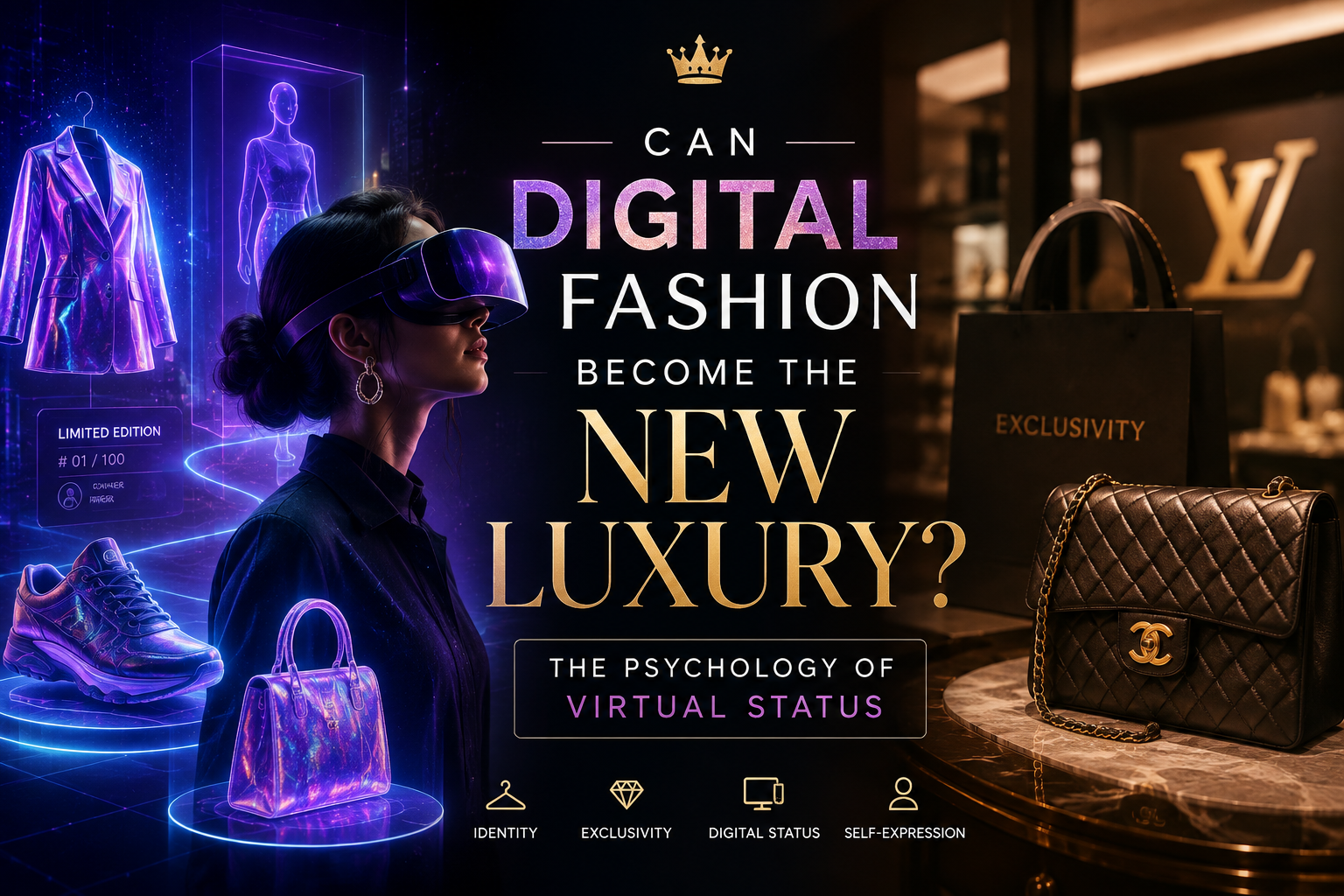
Imagine paying hundreds of dollars for a designer dress that you can never physically wear.
You can’t hang it in your wardrobe. You can’t feel the fabric. You can’t even see it unless you look at a screen.
Yet, someone might still want it.
That is the strange and fascinating world of digital fashion.
From virtual outfits and digital sneakers to clothing designed specifically for avatars and social media photos, fashion is slowly moving beyond the physical wardrobe. And as this happens, an interesting question emerges:
Can digital fashion become the new luxury?
At first, the idea sounds almost ridiculous. Luxury fashion has traditionally been about craftsmanship, rare materials, heritage, exclusivity and the experience of owning something tangible.
But luxury has never really been about the object alone.
It has always been about what the object represents.
And that is where digital fashion gets interesting.
What Exactly Is Digital Fashion?
Digital fashion refers to clothing and accessories that exist primarily in digital form.
Instead of buying a physical handbag or dress, you might purchase a virtual version for your avatar, a digital collectible, or an outfit that can be added to a photograph or video.
Some digital fashion pieces can be worn in virtual worlds, gaming environments or social platforms. Others are created for people who want to enhance their online appearance.
In other words, your digital wardrobe can become just as carefully considered as your physical one.
And this raises an important question: if we spend more of our lives online, could our digital appearance eventually become just as important as our physical appearance?
Why Do We Care About Luxury in the First Place?
To understand whether digital fashion can become luxury, we first need to understand why luxury fashion is desirable.
A luxury handbag isn’t valuable simply because it holds your belongings.
A designer watch doesn’t tell time dramatically better than a cheaper watch.
And a $2,000 pair of shoes doesn’t necessarily make walking more comfortable.
So why do people pay so much?
Because luxury products often communicate something.
They can represent success, taste, identity, exclusivity or social status.
When someone recognizes a luxury brand, the owner may feel that they are being seen in a particular way.
That’s the psychology of status.
We don’t just buy products.
We sometimes buy the feeling and identity attached to those products.
Digital fashion can potentially tap into exactly the same psychological desire.
The Power of Showing Who You Are
Fashion has always been a form of self-expression.
Think about the way people dress for different situations.
Someone might wear a tailored suit to communicate professionalism. Another person might wear vintage clothing to express individuality. Someone else might carefully build a minimalist wardrobe because they want to appear sophisticated.
Our clothes tell stories about us before we even say anything.
But increasingly, people are also expressing themselves online.
Your profile picture, social media posts, gaming avatar and virtual environment can all become extensions of your identity.
That means your digital appearance can become another place where status and personality are communicated.
A person might not need an expensive physical handbag to signal luxury online.
They might use a rare digital accessory instead.
Scarcity Could Make Digital Fashion Feel Luxurious
One of the most important ingredients of luxury is scarcity.
If everyone can easily buy the same item, it usually doesn’t feel particularly exclusive.
Luxury brands understand this extremely well.
Limited collections, exclusive releases and difficult-to-access products can make people want something even more.
Digital fashion can use the same principle.
Imagine a designer releasing only 100 digital versions of a particular handbag.
The handbag doesn’t physically exist, but only 100 people own the digital version.
Suddenly, its value isn’t necessarily about the material.
It’s about rarity.
This is an important psychological shift.
We often desire things more when we believe they are difficult to obtain.
But There’s One Major Problem: Tangibility
There is still a huge psychological difference between owning something physical and owning something digital.
When you purchase a luxury handbag, you can touch it.
You can examine the stitching.
You can carry it into a room.
You can store it carefully in your closet.
You may even pass it down to someone else.
Digital fashion doesn’t provide the same physical experience.
And for many luxury consumers, that physical experience is part of what they are paying for.
This is one of the biggest challenges digital fashion faces.
For digital fashion to become the new luxury, consumers may need to stop thinking of value purely in terms of physical ownership.
Social Recognition Matters More Than We Think
There’s another reason luxury works: other people recognize it.
Imagine buying an incredibly rare digital fashion piece that nobody knows exists.
You might love it, but the status benefit could be limited.
Luxury becomes powerful when other people understand what you’re wearing.
That’s why recognizable logos, iconic designs and brand names matter.
Digital fashion will likely face the same challenge.
For virtual status to become meaningful, people need to understand the difference between an ordinary digital outfit and an exclusive one.
Imagine seeing someone’s avatar wearing a digital jacket and immediately knowing:
“That’s a limited-edition piece from one of the most prestigious fashion houses.”
At that point, digital fashion starts behaving much more like traditional luxury.
Younger Consumers May See Things Differently
One reason digital fashion has potential is that younger consumers have grown up spending significant amounts of time online.
For someone who spends hours playing games, creating content or interacting on social platforms, their digital identity isn’t necessarily separate from their real identity.
It’s part of their life.
For these consumers, spending money on a digital item may not seem as strange as it does to someone who grew up believing that value requires physical ownership.
The definition of a wardrobe could eventually expand.
Instead of asking:
“What clothes do I own?”
People might also ask:
“What does my digital wardrobe say about me?”
Could Digital Fashion Ever Be More Exclusive Than Physical Fashion?
Interestingly, digital fashion could eventually offer forms of exclusivity that physical fashion can’t.
A physical designer can only produce and distribute a limited number of physical items.
A digital designer can create something that exists across multiple virtual environments without worrying about manufacturing, shipping or physical storage.
Digital fashion can also be customized.
Imagine owning a virtual jacket that changes depending on your environment, responds to movement or has an appearance that would be impossible to create physically.
At that point, digital fashion isn’t simply copying physical fashion.
It becomes something completely different.
And that could create an entirely new definition of luxury.
The Future May Not Be Physical vs Digital
Perhaps the biggest mistake is thinking that digital fashion needs to replace physical luxury.
It may not.
The future could involve both.
You could own a physical designer handbag and its exclusive digital counterpart.
You could purchase a luxury fashion collection that includes clothing for your body and clothing for your avatar.
You could attend a physical fashion event while simultaneously participating in a digital version of that experience.
In this world, luxury becomes less about physical objects and more about access, identity, experience and exclusivity.
So, Can Digital Fashion Become the New Luxury?
Yes;but probably not in exactly the same way physical luxury works today.
Digital fashion still has to overcome questions about ownership, permanence, authenticity and emotional connection.
But the psychological foundations are already there.
People want to feel unique.
They want to express their identity.
They want access to things other people don’t have.
And, whether we admit it or not, many of us care about how we are perceived by others.
Those desires don’t disappear when we go online.
In fact, as more of our social lives move into digital spaces, they could become even more important.
The luxury handbag of the future may not always hang from someone’s arm.
Sometimes, it might exist on their avatar, in their social media world or inside a virtual environment.
And perhaps the most interesting question isn’t whether digital fashion can become the new luxury.
It’s whether we’re eventually going to stop making such a strong distinction between what is “real” and what is valuable.
Because something doesn’t necessarily have to be physical to make us feel special.
Sometimes, all it has to do is make us feel like we’re someone worth noticing.