Have you ever opened TikTok just to watch a few videos and somehow ended up ordering a skincare product you’ve never heard of before?
Maybe someone said it cleared their acne.
Someone else showed how their hair “finally started growing.”
Another person explained why you’ve been washing your face incorrectly for years.
And before you know it, you’re thinking:
“Wait…maybe I should try this.”
What’s funny is that if a random person walked up to us on the street and started recommending a skincare product, most of us probably wouldn’t take their advice very seriously.
But on TikTok?
We’re different.
We listen.
We watch their before-and-after pictures. We read the comments. We check their other videos. And sometimes, we trust their recommendation enough to spend our money on it.
So why does beauty advice from complete strangers feel so convincing?
We Feel Like We Know Them
One of the biggest reasons is that TikTok doesn’t feel like traditional advertising.
A beauty brand can tell you that its moisturizer is amazing.
But when a woman sits in front of her phone and says,
“I’ve been using this for three weeks, and here’s what happened to my skin,”
it feels different.
You’re watching someone in what appears to be their normal environment.
Maybe she’s sitting in her bedroom.
Maybe she’s getting ready for work.
Maybe she’s filming in her bathroom with no professional lighting.
It feels like you’re listening to a friend.
Of course, you don’t actually know this person.
But after seeing their face repeatedly on your screen, hearing their opinions and watching parts of their daily life, your brain can start to feel familiar with them.
And familiarity can make someone feel more trustworthy.
We See the “Proof” With Our Own Eyes
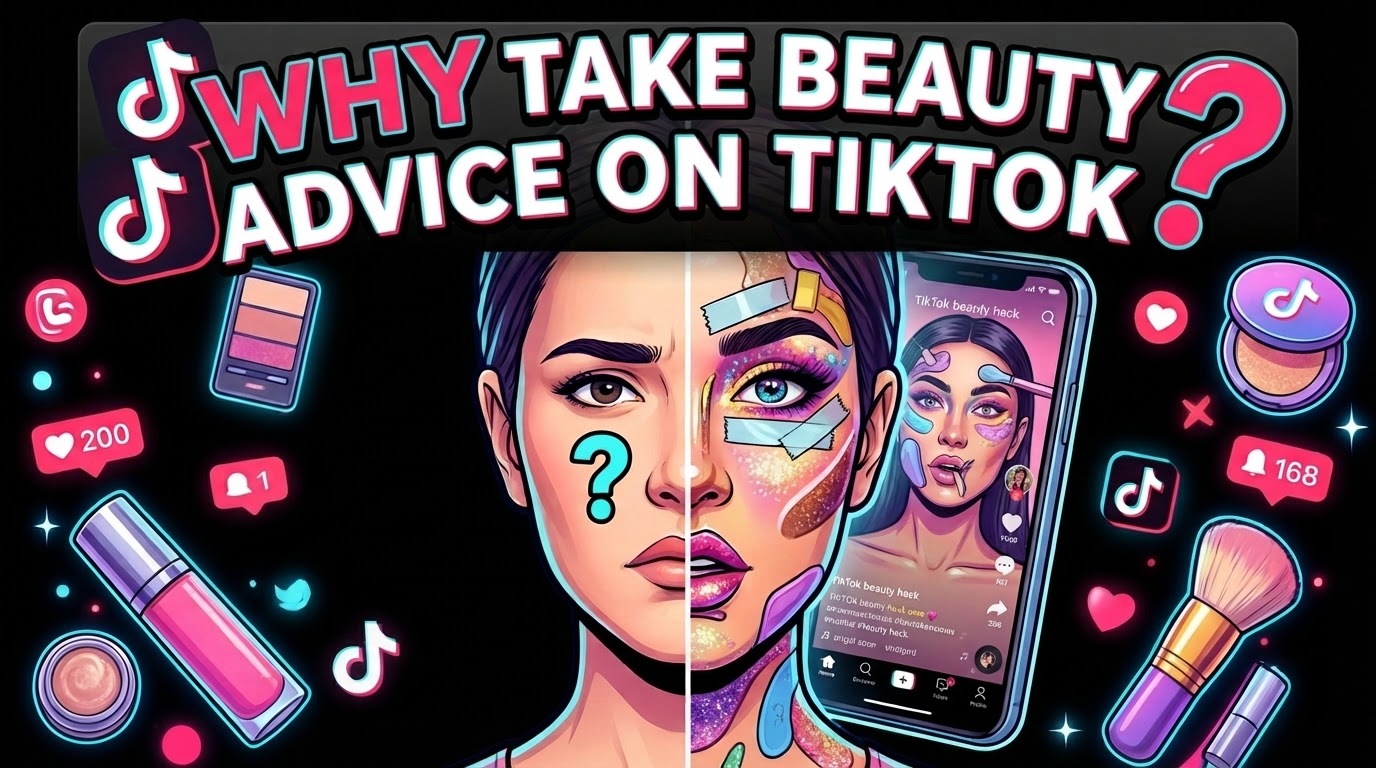
Beauty content is particularly powerful because it’s so visual.
Someone doesn’t just tell you that a product worked.
They show you.
You see the before.
Then you see the after.
You see the close-up of their skin.
You see the hair growth journey.
You see the makeup transformation.
And suddenly the recommendation feels like evidence.
But there’s an important detail we sometimes forget:
Seeing something isn’t always the same as proving something.
Lighting can change.
Camera angles can change.
Makeup can hide imperfections.
Filters can alter skin texture.
Hair can be styled differently.
Even the amount of time between two photographs can influence how dramatic a transformation appears.
That doesn’t mean every beauty creator is being dishonest.
It simply means we shouldn’t automatically treat a visual transformation as scientific proof.
The Comments Make Us Trust It Even More
Here’s where TikTok gets really interesting.
You watch a video recommending a product, then you open the comments.
And suddenly you see:
“This worked for me too!”
“I’ve been using it for two months!”
“Girl, you just saved my skin!”
“I bought it because of you and I love it!”
Now it’s no longer one person recommending something.
It feels like hundreds of people are confirming the recommendation.
This is a form of social proof.
When we’re uncertain about something, seeing other people approve of it can make us more comfortable with the decision.
And beauty is full of uncertainty.
Will this product work for my skin?
Will it make my hair softer?
Will this foundation match me?
Will this actually help with my problem?
When other people appear to have had positive experiences, that uncertainty becomes a little easier to tolerate.
We Trust People Who Seem Like Us
This is another big one.
Imagine a celebrity with completely different skin, hair, lifestyle and budget recommending a product.
You might think:
“Well, of course it works for her. Look at her.”
But then you see someone who looks more like you.
Similar skin tone.
Similar hair texture.
Similar concerns.
Maybe even a similar budget.
Suddenly the recommendation feels much more relevant.
You’re not thinking:
“Does this work for everyone?”
You’re thinking:
“Could this work for me?”
That’s a powerful shift.
We naturally tend to pay more attention to people whose experiences feel familiar to our own.
TikTok Also Makes Beauty Advice Feel Personal
Traditional beauty advertising usually tells you what a product is supposed to do.
TikTok often tells you how someone used it.
And that little difference matters.
Instead of:
“Our serum improves the appearance of your skin.”
you might hear:
“I started putting three drops on my face every night, and this is what happened.”
Now you have a story.
And stories are easier to remember than a list of product benefits.
The creator isn’t just selling you a serum.
They’re giving you a routine to imagine yourself doing.
And once you can picture yourself using the product, buying it becomes much easier to justify.
We See the Recommendation Again and Again
Have you ever seen a product once and ignored it?
Then you see it again.
And again.
And suddenly you’re curious.
This is partly because repeated exposure can make something feel more familiar.
A product that seemed completely irrelevant last week might suddenly start feeling like “the product everyone is using.”
And TikTok’s algorithm can make this even stronger.
Once you’ve watched a few videos about skincare, hair care or makeup, the platform may continue showing you similar content.
So you aren’t seeing one recommendation.
You’re seeing a stream of recommendations.
Eventually, your brain can start thinking:
“If everyone is talking about this, there must be something to it.”
But popularity and effectiveness aren’t necessarily the same thing.
We Often Discover Products Through Stories, Not Advertisements
There’s another reason TikTok beauty advice works so well:
We aren’t always looking for a product.
Sometimes we’re looking for an answer.
Maybe you’re struggling with dry skin.
Maybe your hair doesn’t seem to retain length.
Maybe you want to find a foundation that doesn’t look cakey.
So you search for the problem.
And someone appears with a solution.
That’s a very different experience from seeing an advertisement while watching television.
You’re already interested in solving the problem.
The creator simply appears to have the answer.
But Should We Trust Everything We See?
This is where it’s worth slowing down.
TikTok can be an incredible place to discover new ideas, products and routines.
But it isn’t a substitute for professional advice, especially when you’re dealing with persistent skin or hair problems.
A creator can genuinely believe that something worked for them and still be wrong about why it worked.
And what works beautifully for one person may irritate someone else’s skin or simply do nothing for them.
Before trying a viral beauty hack, ask yourself:
What exactly is being claimed?
Is there evidence behind it?
Could there be another explanation for the result?
Is the person selling the product?
Does the recommendation make sense for my skin, hair or situation?
Those few questions can save you from spending money on every product that happens to go viral.
There’s Nothing Wrong With Being Influenced
And honestly, there’s nothing inherently wrong with discovering products through TikTok.
Some genuinely useful beauty products have become popular because real people shared their experiences online.
The problem isn’t being influenced.
The problem is assuming that popularity automatically means something works.
You can enjoy beauty content and still be skeptical.
You can save a recommendation without immediately buying it.
You can be curious without being convinced.
And you can absolutely change your mind after doing a little more research.
Maybe That’s Why TikTok Beauty Feels So Powerful
When you think about it, TikTok combines several things that naturally influence how we make decisions:
Familiarity.
Social proof.
Visual evidence.
Stories.
People who feel relatable.
Repeated exposure.
And then it puts all of that into a short video you can watch while lying in bed.
Of course we’re influenced.
But the next time you find yourself adding a viral beauty product to your cart after watching a 30-second video, pause for a moment.
Ask yourself:
“Do I actually want this product, or have I simply seen it enough times to start believing I need it?”
Sometimes the answer will be that the product really is worth trying.
And sometimes you’ll realize you were just caught up in the magic of the algorithm.
Either way, a little curiosity is good—but a little skepticism is even better.