
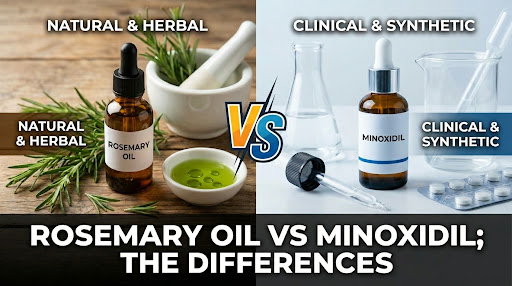
If you’ve been searching for ways to grow your hair, you’ve probably encountered two very different names: rosemary oil and minoxidil.
Thank you for reading this post, don't forget to subscribe!One is a plant-based ingredient that has become incredibly popular on social media.
The other is a medication that has been used for hair loss for decades.
And this is where things get confusing.
You see someone online saying, “Rosemary oil works just as well as minoxidil!”
Then someone else says, “Don’t waste your time with rosemary. Use minoxidil.”
So which one actually makes more sense?
And is rosemary oil really a natural alternative to minoxidil?
Let’s break it down.
First, They’re Not Really the Same Thing
The biggest difference is simple:
Rosemary oil is a botanical essential oil. Minoxidil is a medication.
Rosemary oil has traditionally been used in hair and scalp care, and researchers have investigated whether it may have a role in hair growth.
Minoxidil, on the other hand, has a much larger body of clinical research behind it and is an established treatment for certain types of hair loss.
That doesn’t automatically make one “better” for every person.
But it does mean we shouldn’t treat the two as though they have exactly the same level of scientific evidence.
So Why Is Rosemary Oil Compared With Minoxidil?
This comparison largely comes from a small but frequently cited clinical study published in 2015.
Researchers studied 100 people with androgenetic alopecia, a common form of pattern hair loss. Half used rosemary oil and half used 2% minoxidil for six months.
Interestingly, neither group had a significant increase in hair count after three months.
But after six months, both groups had significantly increased hair counts compared with baseline. The researchers also found no statistically significant difference in hair count between the two groups at six months.
And this is probably where the famous internet claim came from:
“Rosemary oil works as well as minoxidil.”
But there’s an important problem with interpreting the study that way.
One Study Doesn’t Tell the Whole Story
The study is interesting, but it was relatively small and compared rosemary oil with 2% minoxidil, not every formulation or concentration of minoxidil.
So we can’t take those findings and conclude that rosemary oil is universally equivalent to minoxidil.
That’s an important distinction.
A study can give us an encouraging signal without giving us the final answer.
More recent evidence continues to recognize rosemary oil as a potentially promising nonconventional treatment, but the evidence base is much smaller than the one supporting conventional treatments such as minoxidil. A recent Canadian expert consensus specifically recommends topical minoxidil among treatments for androgenetic alopecia, while rosemary oil was not recommended in that consensus.
In other words:
Rosemary oil is interesting. Minoxidil is better established.
How Does Minoxidil Work?
Minoxidil is a topical medication used to treat certain types of hair loss.
Researchers believe it can help prolong the growth phase of hair follicles and increase hair production, although its exact mechanism isn’t completely understood.
And unlike rosemary oil, minoxidil has been studied extensively.
A systematic review and meta-analysis found that topical minoxidil produced significantly greater hair growth than placebo in people with androgenetic alopecia.
That’s why you’ll see minoxidil appearing consistently in medical discussions about pattern hair loss.
It isn’t simply a viral hair-growth ingredient.
There’s a substantial research history behind it.
What About Rosemary Oil?
Rosemary oil is a little different.
Researchers have proposed several possible ways rosemary may influence the scalp and hair follicles, but we’re still learning how meaningful those effects are in real-world hair growth.
The 2015 clinical trial is certainly encouraging, but it shouldn’t be interpreted as proof that rosemary oil can treat every form of hair loss.
And that’s something social media often leaves out.
A person experiencing breakage from excessive manipulation is dealing with a very different situation from someone experiencing androgenetic alopecia.
A person with nutritional deficiencies has a different problem again.
So before asking, “Rosemary oil or minoxidil?”
You may actually need to ask:
“What is causing my hair loss?”
Rosemary Oil May Not Be the Answer to Every Hair Problem
This is particularly important if you’re focused on natural hair.
Sometimes what looks like “slow growth” is actually poor length retention.
Your hair may be growing from the scalp, but you’re losing length through breakage.
Things like excessive heat, tight hairstyles, rough handling, chemical processing, dryness and repeated manipulation can all affect how much length you retain.
In that situation, putting rosemary oil on your scalp isn’t going to solve the underlying breakage problem.
That’s why hair growth isn’t just about finding the perfect oil.
Your scalp, follicles and hair strands all need different kinds of care.
What About Side Effects?
Neither option should automatically be considered risk-free simply because one comes from a plant.
Essential oils can irritate the skin, particularly when used improperly or in concentrated form.
In the rosemary-versus-minoxidil trial, scalp itching occurred in both groups and was more frequent in the minoxidil group.
Minoxidil can also cause unwanted effects, which is one reason it’s important to follow the instructions for the specific product you’re using and speak with a healthcare professional if you’re unsure whether it’s appropriate for you.
And if you’re experiencing sudden, severe or unexplained hair loss, it’s better to investigate the cause rather than simply adding another product to your routine.
So Which One Should You Choose?
This is where I think the answer becomes much more personal.
If you prefer a botanical ingredient and you’re interested in trying rosemary oil, the available research gives you a reason to be curious—but not a reason to expect miracles.
If you’re dealing with pattern hair loss and want an option with considerably more clinical evidence behind it, minoxidil has the stronger evidence base.
And if your hair loss is significant or getting worse, getting a proper diagnosis is probably more useful than trying to decide between two products based on a TikTok comparison.
Because the right treatment depends on why your hair is thinning in the first place.
The Rosemary Oil vs. Minoxidil Bottom Line
So, is rosemary oil better than minoxidil?
We don’t have enough evidence to say that.
Is rosemary oil completely useless?
No. There is some encouraging clinical evidence, including a randomized trial that found increased hair counts after six months.
But is it accurate to say rosemary oil has been proven to work just as well as minoxidil?
That’s too strong a conclusion from the evidence we currently have.
Minoxidil has a much larger evidence base and remains an established treatment for certain forms of hair loss.
Rosemary oil is the more interesting newcomer—the natural remedy everyone is talking about, with some promising research behind it but plenty still to learn.
And maybe that’s the most sensible way to approach the whole rosemary oil trend.
You don’t have to dismiss it because it’s natural.
And you don’t have to believe every claim because someone on social media says it transformed their hair.
Be curious. Look at the evidence. Know what problem you’re actually trying to solve.
Because when it comes to hair growth, the most viral answer isn’t necessarily the right answer for your scalp.