
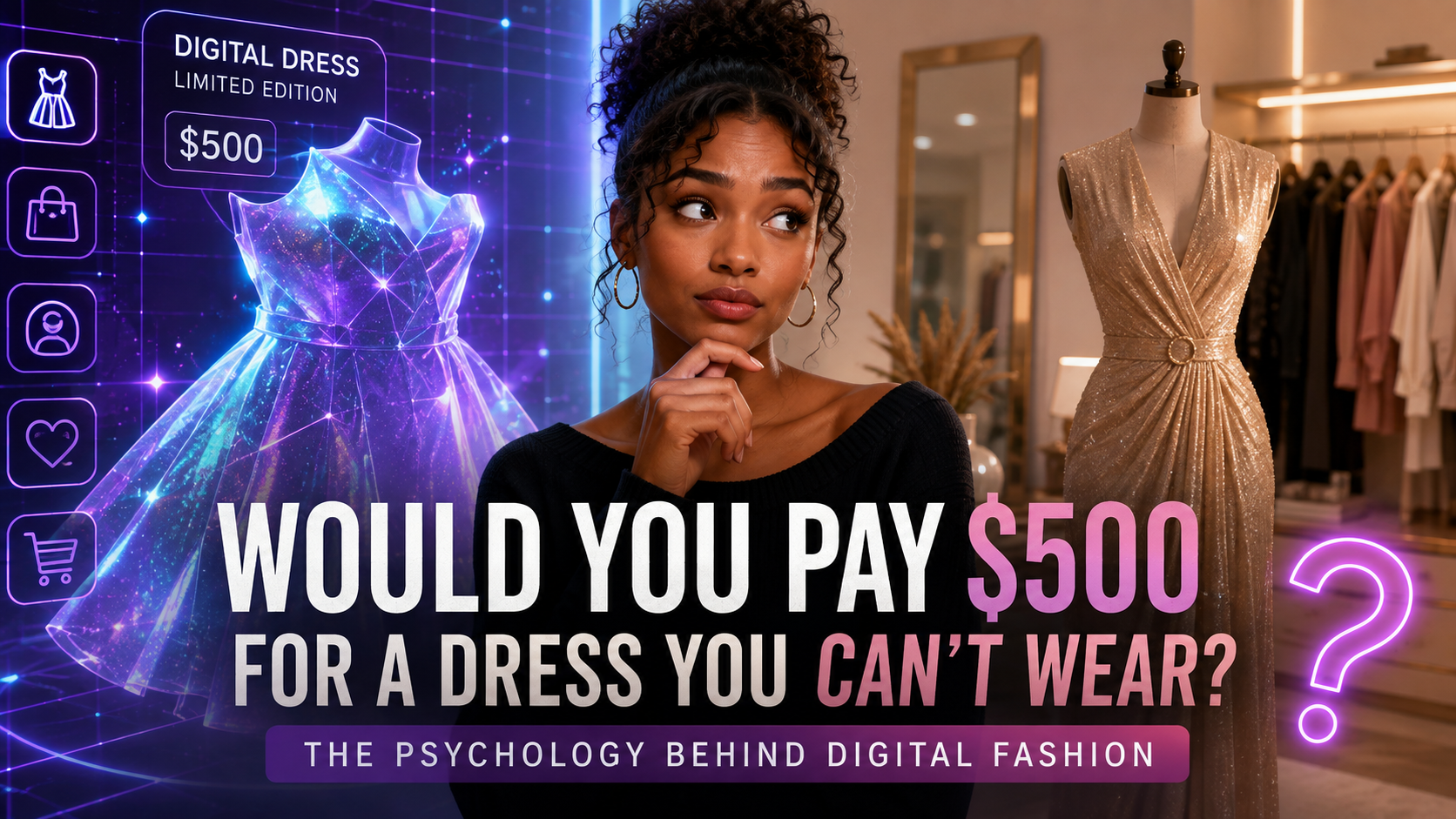
Imagine scrolling through your phone and seeing the most beautiful dress you’ve ever seen.
Thank you for reading this post, don't forget to subscribe!It’s elegant. It’s unique. It looks like something you’d expect to see on a luxury runway.
Then you see the price.
$500.
You think, Okay, that’s expensive… but maybe it’s designer.
Then you realize something.
You can’t actually wear it.
You can’t put it on.
You can’t hang it in your wardrobe.
You can’t wear it to dinner.
It’s a digital dress.
Would you still buy it?
For some people, the answer is surprisingly… yes.
And that’s exactly what makes digital fashion so fascinating.
What Is Digital Fashion Anyway?
Digital fashion is clothing that exists primarily in a digital environment rather than as a physical garment.
Instead of buying a dress made from fabric, you’re purchasing a digital version that can be used in virtual spaces, on avatars, in games, social media content, or even digitally added to photographs and videos.
Think of it as having a wardrobe that exists inside your phone or computer.
And at first, it sounds strange.
Why would anyone spend real money on something they can’t physically wear?
But when you think about it, humans have been spending money on things that aren’t necessarily practical for a very long time.
We buy designer handbags that cost several times more than their functional alternatives.
We buy limited-edition sneakers that we are almost afraid to wear.
We buy expensive watches even though our phones can tell us the time for free.
So perhaps the real question isn’t:
“Why would someone buy digital clothing?”
Maybe it’s:
“Why do we spend so much money on fashion in the first place?”
Fashion Has Never Been Just About Clothing
Let’s be honest.
If fashion were purely about covering our bodies, most of us wouldn’t need that many clothes.
One pair of jeans could probably do the job.
But we don’t stop there.
We want different colors, different styles, different brands and different looks.
Why?
Because clothing has become part of our identity.
What we wear can influence how we feel about ourselves.
A great outfit can make you feel more confident before an important meeting.
A beautiful dress can make you feel special at an event.
Even something as simple as putting on your favorite pair of jeans can make you feel more like yourself.
Digital fashion taps into that same psychological desire for self-expression.
The only difference is that the expression happens in a digital space.
Your Online Appearance Is Becoming Part of Your Identity
Think about how often you see yourself through a screen.
Your social media profile has a picture of you.
Your videos show your outfits.
Your avatar represents you in digital spaces.
You may even spend more time interacting with people online than you realize.
So, naturally, appearance matters there too.
Imagine someone who carefully curates their Instagram feed, chooses specific outfits for their photos, and spends time creating the perfect profile picture.
Would it really be that strange for that person to care about virtual clothing?
Probably not.
In fact, the more time we spend online, the more valuable our digital appearance could become.
And this is one of the reasons the digital fashion industry has so much potential.
But Why Would Anyone Pay $500?
This is where psychology comes in.
When we buy luxury fashion, we’re rarely paying only for the materials.
We’re paying for the story.
We’re paying for the brand.
We’re paying for exclusivity.
We’re paying for craftsmanship.
And sometimes, we’re paying for the feeling that comes with owning something other people can’t easily have.
Digital luxury can create the same feeling.
Imagine a fashion brand releases a virtual dress, but only 50 people can own it.
Suddenly, that dress becomes scarce.
It’s not valuable because it requires hundreds of dollars worth of fabric.
It’s valuable because only a small number of people can have it.
That’s the psychology of scarcity.
When something is difficult to obtain, we often perceive it as more desirable.
And luxury brands have understood this for decades.
The Status Factor
There’s another reason people might spend money on digital clothing: status.
Fashion has always been connected to social status.
A recognizable designer handbag can tell people something about the person carrying it.
A rare pair of sneakers can signal that someone knows a lot about fashion.
A luxury watch can communicate success.
Digital fashion could eventually do something similar.
Imagine entering a virtual event and seeing someone’s avatar wearing a digital outfit that costs $500.
You recognize the designer immediately.
You know it’s a limited release.
Suddenly, that digital outfit becomes a status symbol.
The interesting thing is that the value isn’t necessarily in the clothing itself.
The value is in what the clothing communicates.
But There’s Still Something Missing
Even with all this potential, digital clothing has one major disadvantage.
You can’t touch it.
And that matters.
There’s something deeply satisfying about physical fashion.
You can feel the texture of a beautiful fabric.
You can appreciate the stitching on a handbag.
You can try something on and see how it looks on your actual body.
You can open your wardrobe and physically see the things you’ve collected over the years.
That emotional connection is difficult to reproduce digitally.
A virtual dress might look incredible on your screen, but you can’t feel it against your skin.
And for many people, that’s a big part of the experience.
Then Again, Digital Fashion Has Advantages Too
Digital clothing doesn’t have to follow the rules of physical fashion.
A designer can create something that would be impossible to manufacture in real life.
Imagine a dress made entirely of floating flowers.
Or a jacket that changes color when you move.
Or shoes that appear to glow as you walk through a virtual environment.
Physical fashion has limitations.
Digital fashion doesn’t have to.
It can be imaginative, interactive and completely unrealistic.
And that’s exactly what could make virtual fashion appealing to a new generation of consumers.
We Already Spend Money on Digital Things
Here’s something else to consider.
People already spend real money on digital items.
We buy subscriptions.
We purchase digital games.
We buy virtual accessories for characters.
We pay for digital experiences.
We spend money creating beautiful social media content.
So perhaps buying a digital dress isn’t as strange as it initially sounds.
The difference is simply that we’re still getting used to thinking of digital clothing as something that can have real value.
And that mindset could change.
Will Digital Fashion Replace Physical Fashion?
Probably not.
At least, I don’t think it will completely replace physical clothing.
There will always be something special about getting dressed in the real world.
But I can see digital fashion becoming another layer of our wardrobes.
You might have physical clothes for work, vacations, dinners and everyday life.
And then you might have virtual clothing for your online identity.
One wardrobe for your physical world.
Another for your digital world.
And eventually, the line between the two might become much less obvious.
So, Would I Pay $500 for a Digital Dress?
Honestly?
Probably not.
Not yet.
I’d need to see why that digital dress was worth $500.
Is it rare?
Is it from a respected designer?
Can I use it across different platforms?
Does it represent something about my identity?
Does owning it actually give me an experience I value?
Because that’s what ultimately determines whether digital fashion becomes luxury.
It’s not simply about making a beautiful digital dress.
It’s about making people care about owning it.
And that’s something luxury fashion has always been very good at.
The Real Future of Fashion Might Be Both
Maybe the future isn’t about choosing between physical fashion and digital fashion.
Maybe we’ll simply have both.
You might wear a beautiful physical dress to a party while your digital avatar wears an entirely different version online.
You might own a physical designer handbag and its virtual counterpart.
You might even buy a fashion collection that comes with both physical and digital pieces.
And suddenly, spending $500 on something you can’t physically wear may not seem quite as strange.
Because the value of fashion has never been purely about fabric.
It’s about identity.
It’s about creativity.
It’s about belonging.
It’s about status.
And sometimes, it’s simply about making us feel good.
So would you pay $500 for a dress you can’t wear?
Maybe the more interesting question is this:
If that dress makes you feel confident, unique and part of something exclusive…
does it really matter that you can’t touch it?
For now, I’ll keep my physical wardrobe.
But I’m definitely keeping an eye on the digital one.
Because fashion has always evolved with the way we live.
And if more of our lives move online, our wardrobes might just follow us there.