
If you have natural hair, you’ve probably heard the shea butter conversation many times.
Thank you for reading this post, don't forget to subscribe!“Use shea butter to seal in moisture.”
“Mix it with an oil.”
“Put it on your ends.”
For some women, shea butter is one of those products they can use without thinking twice. Their hair feels soft, their twists look good, and somehow that little jar seems to last forever.
Then there are women who try it and think, Why does my hair feel like this?
Their hair feels heavy. Their strands feel coated. Maybe it gets greasy faster than usual. Maybe they simply don’t like how their hair feels after using it.
So which experience is the “right” one?
Neither; and that’s the point.
Shea butter can be a useful ingredient for natural hair, but that doesn’t mean every woman needs to use it in the same way. Shea-derived ingredients are commonly used in cosmetics as skin and hair-conditioning agents, but the evidence specifically surrounding raw shea butter and every claimed benefit for natural hair is much more limited than the internet sometimes makes it sound.
The better question isn’t simply, “Is shea butter good for natural hair?”
It’s “Does shea butter work well for my hair, and am I using it in a way that makes sense for my routine?”
Why Is Shea Butter So Popular for Natural Hair?
Part of the answer is practical, and part of it is cultural.
Shea butter has a long history of use in African skin and hair care, so it isn’t just another ingredient that appeared because of a new beauty trend. For many women, it’s familiar.
Then there’s the texture.
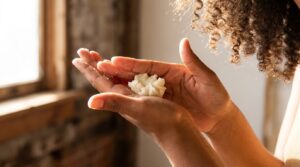
Raw shea butter is rich and creamy once warmed between your hands, making it appealing when your hair feels dry and needs something more substantial than a lightweight product.
It’s also incredibly versatile. Shea-derived ingredients appear in conditioners, creams, styling products and other hair-care formulas.
But there is a difference between an ingredient being useful and an ingredient being necessary.
Natural hair doesn’t automatically need the richest product available.
What Are the Potential Benefits of Shea Butter for Natural Hair?
It can help hair feel softer
Shea-derived ingredients are used in cosmetics as conditioning agents. In practical terms, that means they can help improve the feel and manageability of the hair.
If your hair tends to feel rough or dry, a richer product containing shea butter may leave it feeling softer and more conditioned.
But don’t confuse a softer-feeling strand with proof that the ingredient has “repaired” damaged hair. Hair that has already been damaged cannot simply be restored to its original state by applying a butter.
It can be useful when you prefer richer products
Some natural-hair routines work better with lightweight products.
Others don’t.
If your hair responds well to richer creams and butters, shea butter can be a useful part of that routine.
This is particularly relevant if you tend to find lightweight products disappear from your hair quickly and prefer something with a richer texture.
It can make styling more comfortable
A small amount of a rich conditioning product can make the hair feel softer and easier to manipulate.
That can be useful when you’re preparing your hair for twists, braids or other low-manipulation styles.
The important part is small amount.
Raw shea butter is rich, so you don’t necessarily need to cover every strand in it.
Can Shea Butter Be Bad for Natural Hair?
This is where the conversation usually gets too simple.
You’ll sometimes see people describe shea butter as either a miracle ingredient or something that “clogs” the hair.
Neither extreme is particularly helpful.
The more realistic issue is that raw shea butter is a rich, relatively heavy product, and some people’s hair simply doesn’t respond well to that kind of routine.
Here are some things you might notice.
Your hair feels heavy
If your hair normally feels light and fluffy but suddenly feels weighed down after using shea butter, you may simply be using more richness than your hair needs.
That doesn’t mean your hair is damaged.
It may just mean that the product isn’t a good match for the amount you’re using.
Your hair feels coated
Repeatedly applying a rich product without cleansing can leave some people’s hair feeling coated.
This is one reason why adding more product isn’t always the answer when your hair feels dry.
Sometimes your routine needs to go in the opposite direction: cleanse, reset and start again with less product.
Your hair looks or feels greasy
Raw shea butter is not a lightweight serum.
If you’re heavy-handed with it, the result can be greasy hair rather than soft, conditioned hair.
This is particularly easy to do when you’re trying to distribute the butter evenly and keep adding more because you feel like certain areas haven’t been covered.
You probably don’t need as much as you think.
Your hair doesn’t feel moisturized
This one is worth paying attention to.
Shea butter is rich and conditioning, but it shouldn’t be treated as though it is the same thing as water or a water-based moisturizer.
If your hair is already very dry, applying a thick layer of butter over it isn’t necessarily going to solve the underlying problem.
A better approach is to think about your whole routine rather than asking one ingredient to do everything.
Can Shea Butter Cause Hair Loss?
This is probably the question that makes people nervous enough to search for “side effects of shea butter for natural hair” in the first place.
The important distinction is this:
There isn’t good evidence that normal use of shea butter itself causes hair loss.
So if you’re experiencing noticeable thinning or excessive shedding, don’t automatically conclude that shea butter is the culprit.
Hair loss can have many causes, and current research on hair-loss treatments also highlights how limited the evidence can be for many natural or plant-based approaches.
There is, however, another issue worth knowing about.
Some people can develop an allergic or irritant reaction to cosmetic ingredients. A published case report documented contact allergy to shea butter, although a single case report does not tell us how commonly this occurs.
So if you develop significant itching, redness, swelling or irritation after using a shea-butter product, don’t keep applying it simply because it’s considered “natural.”
And if you’re experiencing persistent hair loss or scalp symptoms, it’s better to get the cause properly assessed rather than blaming one ingredient.
How Do You Know If Your Hair Doesn’t Like Shea Butter?
This is the part I think is more useful than a simple list of “side effects.”
Instead of asking whether shea butter is universally good or bad, pay attention to what happens after you use it.
Your hair may not be responding well to your current use of shea butter if it consistently:
- feels unusually heavy
- becomes greasy quickly
- feels coated rather than soft
- becomes difficult to cleanse
- seems difficult to moisturize despite repeated product application
- loses the movement or softness you normally like
None of these automatically means shea butter is damaging your hair.
They may simply be signs that the amount, frequency or type of product isn’t working for you.
That’s an important distinction.
How Much Shea Butter Should You Use?
There isn’t one universal amount that works for everyone.
And honestly, this is where many natural-hair routines go wrong.
You see someone with thick, dense hair using a generous amount of product and assume you should do the same.
But your hair may not need it.
Start with a small amount. Warm it between your palms and apply it where you actually need it instead of automatically coating your entire head.
You can always add more.
It’s much easier to add a little extra than to spend the next wash day trying to remove half a jar from your hair.
Should You Put Shea Butter Directly on Your Scalp?
This is another area where I wouldn’t recommend treating one routine as a universal rule.
Some people apply shea butter to their scalp because it feels soothing or because they’ve always done it that way.
But if your scalp becomes itchy, irritated, unusually greasy or uncomfortable, there’s no reason to keep applying it simply because it’s part of a traditional routine.
And remember that the scalp is skin.
If you have an ongoing scalp condition, severe itching, inflammation or unusual scaling, hair butter isn’t a substitute for getting the problem properly assessed.
When Might You Want to Avoid Shea Butter?
You don’t necessarily have to permanently “avoid” shea butter just because you’ve had one bad experience with it.
But there are situations where stepping back makes sense.
For example, if:
- your hair consistently feels weighed down by it
- you dislike the greasy texture
- you repeatedly experience irritation after using a particular product
- you find yourself relying on increasingly large amounts
- your hair-care routine works perfectly well without it
And if you’ve experienced a suspected allergic reaction, don’t simply keep experimenting with the ingredient on your own.
Natural doesn’t mean impossible to react to. Documented contact allergy to shea butter has been reported.
Why We Sometimes Assume Natural Ingredients Must Be Good for Everyone
There’s something interesting about the way we talk about natural hair ingredients.
Once an ingredient earns a reputation as a “natural hair staple,” it can become very easy to stop questioning whether it actually suits us.
Shea butter is a good example.
Because it’s natural, familiar and deeply connected to African beauty traditions, it can feel almost wrong to say, “My hair doesn’t like it.”
But your hair doesn’t owe an ingredient loyalty.
Natural doesn’t mean universally suitable.
One woman can use shea butter and love the result. Another can use the same ingredient and decide that it makes her hair too heavy.
Both experiences can be completely valid.
And you don’t have to force your hair into someone else’s routine simply because that routine is popular.
So, Is Shea Butter Good for Natural Hair?
It can be.
Shea butter and shea-derived ingredients have a legitimate place in hair care, particularly as conditioning ingredients. But that doesn’t mean raw shea butter is essential for every natural-hair routine or that using more will give you better results.
If your hair feels soft, manageable and healthy with it, there’s no reason to stop using it simply because someone else prefers a different ingredient.
If your hair feels heavy, greasy or coated every time you use it, that’s information too.
You may need less.
You may need it less often.
You may prefer a lighter product.
Or you may simply decide that shea butter isn’t necessary for your routine.
The goal isn’t to build a natural-hair routine around the ingredients everyone says you should use.
It’s to understand what your hair actually responds to.
And sometimes, the best hair-care decision isn’t adding another product.
It’s knowing when you don’t need one.