Imagine walking into a room carrying a designer handbag that costs thousands of dollars.
People recognize it immediately.
They know the brand.
They know it’s expensive.
And whether we like to admit it or not, they may make assumptions about you because of it.
Now imagine a different scenario.
You’re attending a virtual event, and someone’s avatar walks in wearing a digital outfit that only 50 people in the world own.
You recognize it instantly.
You know the designer.
You know it’s rare.
And suddenly, you’re thinking:
“Wow. That’s exclusive.”
So here’s the question:
Which one represents more status; the physical luxury item or the digital one?
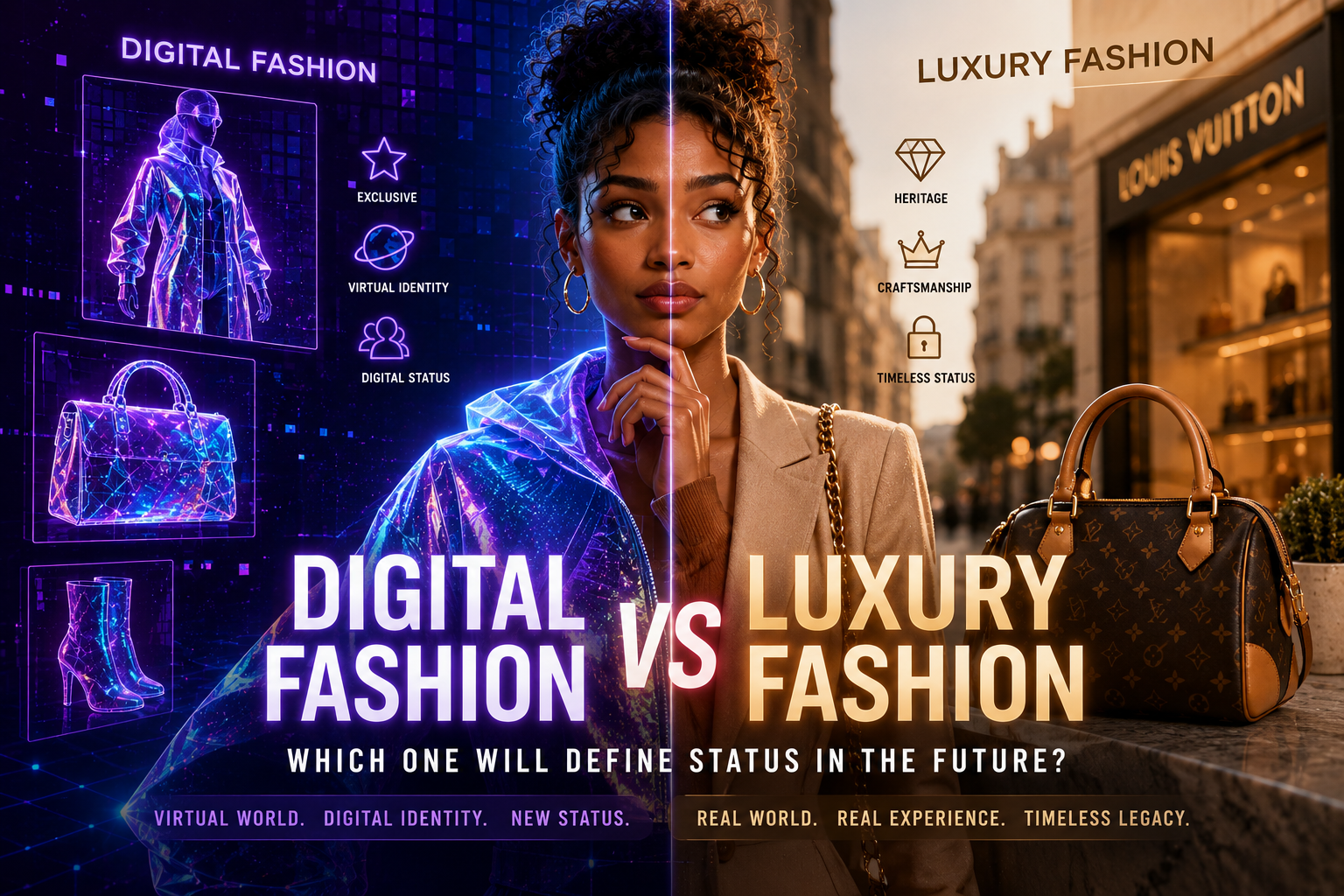
It might sound like a strange question today, but as our lives become increasingly digital, the competition between digital fashion vs luxury fashion could become much more interesting.
Why Do We Care About Fashion Status?
Let’s be honest.
Fashion isn’t only about looking good.
It can also communicate something about us.
The clothes we wear can tell people whether we’re casual, professional, creative, minimalist, trendy, or interested in luxury.
Sometimes we intentionally choose certain brands because of what those brands represent.
That’s why a luxury handbag can mean more than just a handbag.
It can communicate success.
A designer shoe can communicate taste.
A rare watch can communicate wealth.
Fashion becomes a language.
And status is one of the things that language communicates.
But here’s where things get interesting.
That language is increasingly being spoken online.
Luxury Fashion Has Had a Head Start
Traditional luxury fashion has spent decades;or even centuries, building its reputation.
Luxury brands have stories.
They have recognizable designs.
They have carefully controlled images.
They create limited collections.
They hold exclusive fashion shows.
And, importantly, people recognize their names.
When you see certain logos or designs, you already have an idea of what they represent.
That’s powerful.
Because luxury isn’t simply about making an expensive product.
It’s about creating a perception of value around that product.
And this is something digital fashion is still trying to establish.
Digital Fashion Is Playing by Different Rules
Digital fashion doesn’t need to copy everything physical fashion does.
In fact, it can create its own rules.
A digital dress doesn’t have to be made from cotton, silk, leather, or any other physical material.
It can glow.
It can move in impossible ways.
It can change colors.
It can transform.
It can even look completely different depending on where you’re viewing it.
That opens up an entirely new world of creativity.
And for people who spend a lot of time online, that creativity can become part of their identity.
Your Digital Identity Could Become a Status Symbol
Think about your social media profile.
It’s not just a random collection of pictures.
Most people carefully choose what they show.
The photos.
The outfits.
The locations.
The captions.
Even the way they present themselves.
We’re already curating our digital identities.
Now imagine adding virtual fashion to that identity.
Your avatar might wear a rare digital jacket.
Your virtual character might have an exclusive designer handbag.
Your digital profile could feature fashion pieces that are unavailable to almost everyone else.
Suddenly, your digital wardrobe becomes another way of communicating status.
And that’s where digital fashion could start competing with traditional luxury.
Scarcity Could Make Digital Fashion Extremely Desirable
Here’s something both physical and digital luxury understand very well:
People want what they can’t easily have.
Imagine a designer creates a digital handbag and makes only 100 copies available.
There is no physical manufacturing.
No shipping.
No warehouse.
Yet only 100 people can own it.
That scarcity could make the item incredibly desirable.
And because the fashion piece exists digitally, its owner can potentially display it across different online experiences.
The product may not be sitting inside a closet.
But it can still be seen.
And visibility is important when we’re talking about status.
But Physical Luxury Has Something Digital Fashion Doesn’t
There’s one thing physical luxury will probably always have an advantage with:
the experience of actually owning something tangible.
There’s a special feeling that comes with holding a beautifully made handbag.
You can feel the material.
You can see the craftsmanship.
You can wear it.
You can pass it down.
You can keep it for years.
There’s also something emotional about opening a luxury box and discovering the item inside.
Digital fashion can’t completely reproduce that experience.
At least not yet.
And that’s why I don’t think physical luxury fashion is simply going to disappear.
So What Makes Digital Fashion Different?
The biggest difference may be that digital fashion doesn’t necessarily have to compete for space in your physical wardrobe.
You could have both.
Think about it.
Your physical wardrobe might contain your everyday clothes, work outfits, vacation pieces, and special occasion dresses.
Your digital wardrobe could contain completely different things.
Maybe you have an outfit for your avatar.
Another for your social media content.
Another for a virtual event.
Another just because you think it looks amazing.
And suddenly, fashion becomes less about what you physically own and more about how many different versions of yourself you can express.
The Younger Generation May Change the Definition of Status
This is where the future gets particularly interesting.
For people who have grown up online, digital experiences aren’t necessarily seen as less real.
Gaming communities, social platforms, virtual worlds, and online communities are already important parts of everyday life.
If someone spends hours every day in a digital environment, why wouldn’t they care about how their avatar looks?
And if their friends recognize a particular digital designer, owning that designer’s clothing could become meaningful.
The same psychology that makes someone proud of owning a rare physical sneaker could eventually make someone proud of owning a rare virtual one.
The object has changed.
The desire hasn’t.
Digital Status Could Become Its Own Category
Perhaps we’re making the wrong comparison.
Maybe the future isn’t about digital fashion vs luxury fashion.
Maybe digital fashion will simply create a new category of status.
Physical luxury could continue to represent wealth and craftsmanship in the real world.
Digital luxury could represent creativity, influence, online reputation, and access within digital spaces.
One person might have an impressive physical wardrobe.
Another might have an incredibly exclusive digital collection.
And both could be considered fashionable in completely different ways.
What About Social Recognition?
There’s one major factor that could determine whether digital fashion truly becomes a status symbol:
Will people care?
That’s the real test.
A digital outfit only becomes socially valuable if other people recognize its value.
Imagine wearing an extremely rare virtual designer jacket, but nobody knows what it is.
You might love it, but the status signal disappears.
For digital luxury to succeed, brands will need to build recognition.
People will need to know:
“That’s a rare piece.”
“That’s from that designer.”
“Only a few people own that.”
Once that happens, digital fashion becomes much more than decoration.
It becomes communication.
Will Digital Fashion Replace Luxury Fashion?
I don’t think it will.
At least, not completely.
Physical fashion satisfies needs that digital fashion simply can’t.
We still need clothes in the real world.
We still enjoy touching beautiful fabrics.
We still want to dress up for weddings, dinners, vacations, work, and special occasions.
And there will always be something appealing about physically owning a beautiful object.
But I do think digital fashion could redefine what status looks like.
The people who have the most influence in the future might not only be showing off their physical wardrobes.
They may also be showing off their digital ones.
The Future Might Be About Both
Imagine a future where you buy a luxury collection and receive both physical and digital versions.
You wear the physical dress to a real event.
Then later, your avatar wears the digital version in a virtual environment.
The same designer exists in both worlds.
The same brand carries status in both worlds.
But each version offers a completely different experience.
That future doesn’t sound so strange anymore, does it?
So, Which One Will Define Status?
The honest answer is:
Probably both; but in different ways.
Luxury fashion will continue to represent craftsmanship, heritage, physical quality, and traditional forms of wealth.
Digital fashion could increasingly represent creativity, online identity, exclusivity, and digital influence.
And the most interesting part is that the two worlds may eventually overlap.
Because fashion has always adapted to the way we live.
When people moved from formal workplaces to more casual environments, fashion changed.
When social media became part of everyday life, fashion changed.
And as more of our lives move into digital spaces, fashion will change again.
So perhaps the future isn’t about choosing between a designer handbag and a digital handbag.
Maybe one day, having both will simply be normal.
And the definition of being “fashionable” won’t depend entirely on what you’re wearing in the real world.
It might also depend on who you are when you’re online.
Because ultimately, status has never really been about the object.
It’s about the story the object tells about you.
And in the future, that story might be told through both physical luxury fashion and digital fashion.